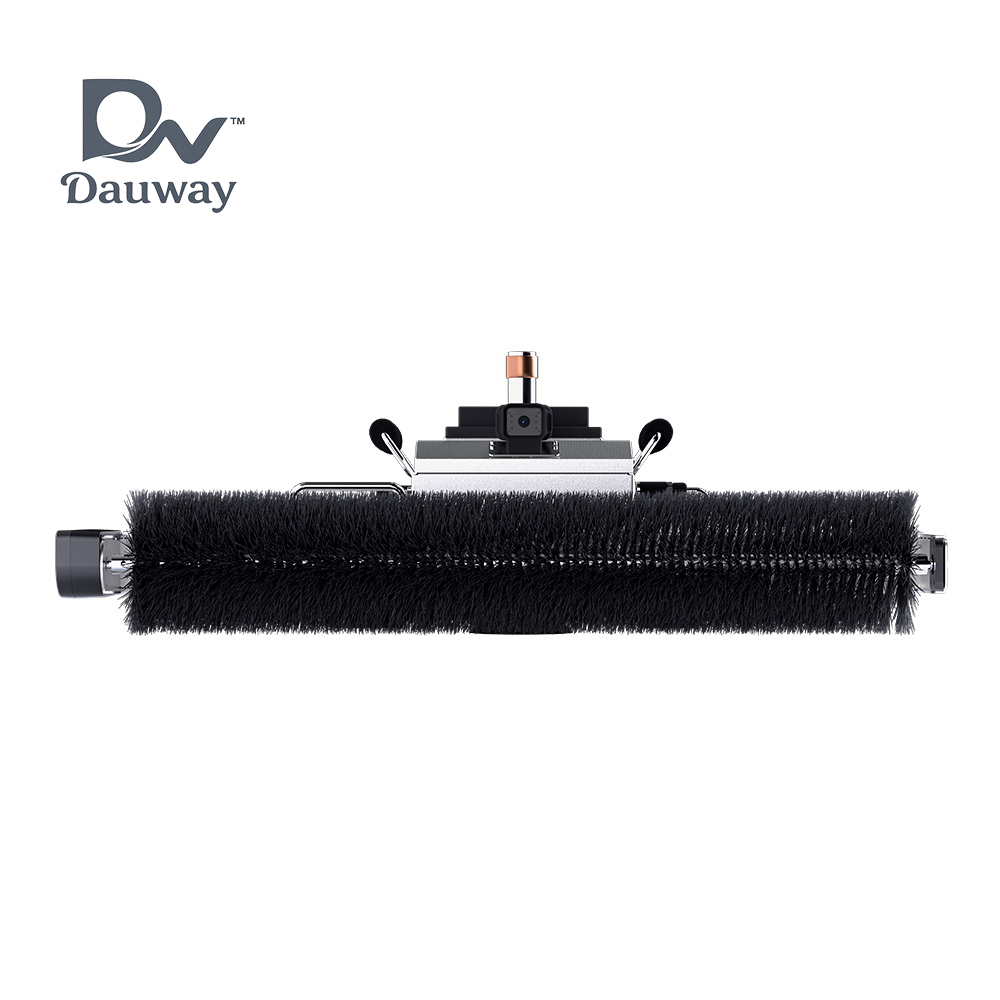
Millimeter-class fully autonomous positioning & navigation is achieved by employing self-developed AI visual recognition mechanism, which underpins accurate recognition, fast edge computing & processing and precise location, mainly including dynamic exposure compensation camera and smart AI model.
Besides aforementioned high-definition camera, the surrounding perception capability is further enhanced by multi-modal data fusion and multiple-sensor cross-verification from inertial measurement unit (IMU), ultrasonic radar and infrared thermal imaging, to construct a 3D environment modeling. which makes it highly adaptive to diverse soiling types, light conditions, and photovoltaic layout arrangements.
Our AI model, the decision-making brain, is trained on massive data gleaned from real world solar cleaning application projects, capable of handling complex site conditions. Rather than relying on pre-defined routes, we adopt deep reinforcement learning (DRL) technology to realize dynamic path planning, with end-to-end response time less than 30ms, supporting millisecond-level adjustment & correction. Thus 100% cleaning coverage is guaranteed by ensuring no redundant overlapping or missed areas along the cleaning route.
When perceived by the AI vision system, the wide solar arrays are instantly segmented into multiple lanes for the robot to navigate and clean one by one. The complete self-operation process comes from key motion metrics such as straightness of proceeding, precision of steering and alignment of lane splicing.
Suction cup-assisted 360-degree in-situ rotation, lays the foundation for subsequent straight-line movement. When changing lanes, the robot performs precise in-situ turning to ensure that the body is aligned with the starting position of the next lane.
What’s more, we bring speed-adaptation function into auto driving to balance efficiency and quality. Our AI model is responsible for calculating the optimal speed range in real time based on cleaning quality requirements and absolute safety baselines, avoiding insufficient and inefficient cleaning. To maximize cleaning effectiveness while ensuring operation safety, the optimal travel speed is dynamically regulated, by analyzing the interaction between brush rotation speed, surface pressure, moving speed, the friction coefficient, tilt angle and operation safety margin.
A two-step soiling removal process further improves edge cleaning efficiency:
- Overboard pushing action first sweeps the muddy dirt beyond the panel area, before it could reach the frame, preventing secondary accumulation at the photovoltaic panel edges;
- Then followed by edge deep cleaning action to thoroughly solve stubborn stains built up on the lower edges, which may lead to hot spot phenomenon and an average 6%-15% power generation loss-a common blind spot for other regular cleaning equipment with ordinary roller brushes that cannot reach it properly or clean it thoroughly.
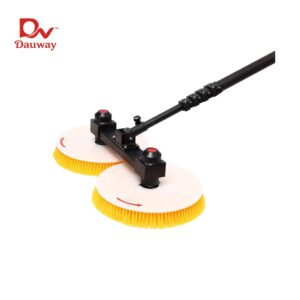
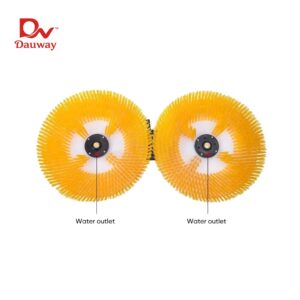
The outstanding cleaning execution architecture follows the same pattern as other smart robot series: dual flexible polymer brushes that can optimize contact angle and pressure of the bristles to the panels, are mounted on lightweight driving chassis with closed-loop torque control function, effectively performing targeted cleaning and avoiding microcracks after tens of thousands of cleaning cycles.
Thanks to precise visual recognition system, auto deceleration is triggered when the robot approaches the solar array edge for fall protection, with an emergency braking response time of 41ms, reducing the falling probability to less than 1 in 100 million; For anti-slip protection, our powerful AI model, trained on accurately labeled real-scenario database, can predict skidding risks and proactively correct course instantly on wet surfaces, through dynamic regulation of the driving motor power to suppresses slippage cases, achieving a success rate above 99.9%.
A central data management platform is set up to track the robotic cleaning process, uploading operational data in real time, across multiple dimensions: cleaning quality, robot reliability, panel health and power generation (Data access required from solar inverters, power meter, and solar total irradiance monitor), allowing station owner and operators to check it remotely via a mobile app or platform backend.
Synergy effect is achieved with inspection. The robot automatically performs panel inspections during cleaning operations by integration with dual-spectrum inspection modules: an infrared thermal imaging instrument and high-resolution visible light camera. The inspection data is automatically uploaded to the same O&M platform and presented to the maintenance personnel for monitoring and supervision purposes.